
Karya Tulis
Karya Tulis Dosen
Jelajahi koleksi karya tulis dosen Poltekkes Kemenkes Malang.
Menampilkan
1181–1190
dari
1395
karya tulis dosen
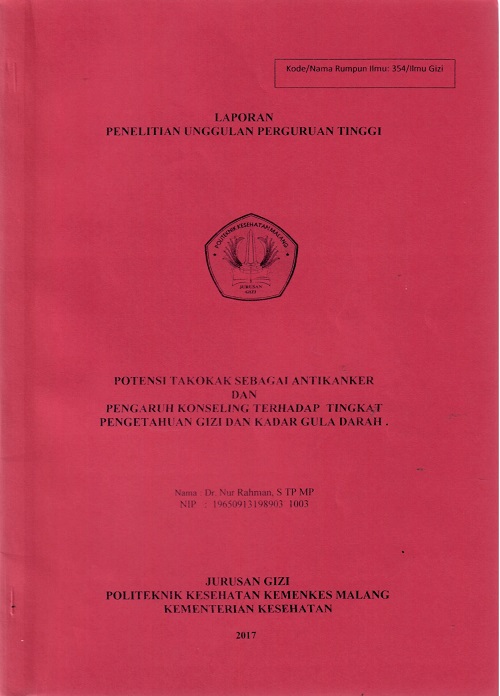
2017
POTENSI TAKOKAK SEBAGAI ANTI KANKER DAN PENGARUH KONSELING TERHADAP TINGKAT PENGETAHUAN GIZI DAN KADAR GULA DARAH
Lihat Detail Karya
Subjek:
TAKOKAK,KONSELING
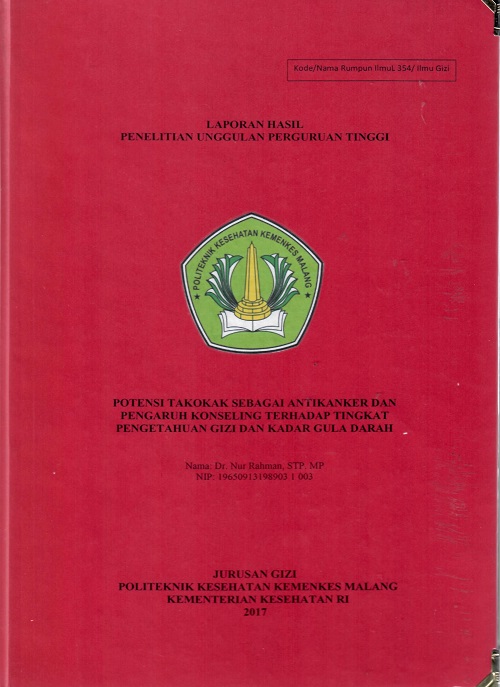
2017
POTENSI TAKOKAK SEBAGAI ANTI KANKER DAN PENGARUH KONSELING TERHADAP TINGKAT PENGETAHUAN GIZI DAN KADAR GULA DARAH
Lihat Detail Karya
Subjek:
TAKOKAK,KONSELING,TINGKAT PENGETAHUAN GIZI,KADAR GULA DARAH
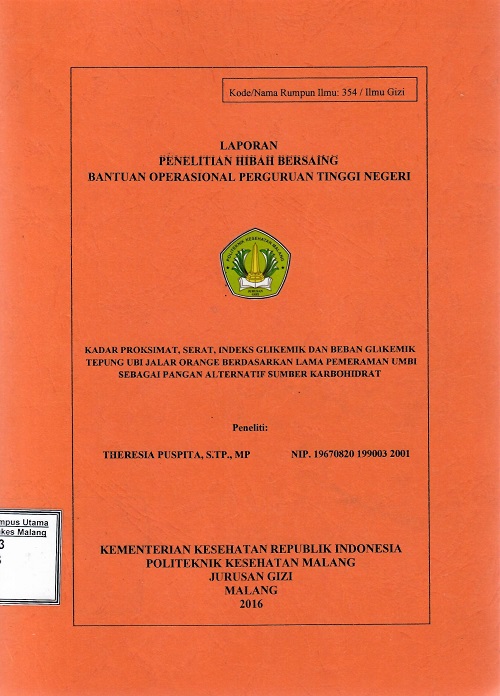
2017
PRA-TREATMENT DENGAN BLANCHING-COOLING PADA PROSES PENEPUNGAN TERHADAP KADAR PROKSIMAT, PROFILPATI DAN SIFAT FISIKO-KIMIA TEPUNG UBI JALAR PUTIH SEBAGAI PANGAN SUMBER KH
Lihat Detail Karya
Subjek:
BLANCHING-COOLING,TEPUNG UBI JALAR PUTIH
Karya Tulis
2017
Prevalensi Picky Eater pada Anak Usia Prasekolah di Kota Malang dan Hubungannya dengan Status Gizi dan Asupan Makan
Lihat Detail KaryaLihat Abstraksi
ABSTRACT
Background: Picky eater, can cause deficit nutrition intake that can affect the nutritional
status (become underweight). The further effect of underweight is its influence on growth
and development, both physically and cognitively which may further have an impact on
morbidity and mortality rates.
Objective: This study aimed to find out the prevalence of picky eater in pre school age
children in Malang and analyze its relation with nutritional status and food intake.
Methods: In this cross-sectional study, mothers (n = 139) of children aged 3-5 years were
recruited from 12 integrated health care centers in Janti Malang, between October-November 2017 using purposive sampling technique. In this study, the interview was
conducted to determine the child into the category of picky eater and non picky eater
based on Children's Eating Behavior Questionnaire (CEBQ). In addition, anthropometric
measurements of height and weight were taken to determine the nutritional status of
children. Children’s food intake (energy, protein, and zinc) were collected through
interviews using a 3x24 hour food recall form. The collected data was then analyzed to
see the prevalence of picky eater based on CEBQ questionnaire, and also analyzed the
relationship between t wo variables. The association of picky eater with nutritional status
was tested using Kolmogorov-Smirnov Test, while the picky eater relationship with
intake of food was tested using Mann-Whitney Test.
Results: The proportion of picky eater children is 12.2%. Children with severe
malnutrition is 1.4%, 8.6% short children, 3.6% very short children, and 5.8% thin
children. There was no relationship between the status of picky eater with nutritional
status and food intake (p <0.05).
Conclusion: Picky eater children may still have good nutritional status, possibly because
the state of the picky eater has not lasted long. While adequate intake in picky eater
children is likely due to the compensation of food consumption in addition to main meals
that can meet nut ritional needs.
Keywords: picky eater, children 3-5 years old, nutitional status, nutrition intake
Karya Tulis
2017
PREVALENSI PICKY EATER PADA ANAK USIA PRASEKOLAH DI KOTA MALANG DAN HUBUNGANNYA DENGAN STATUS GIZI DAN ASUPAN MAKAN
Lihat Detail Karya
Subjek:
PICKY EATER,STATUS GIZI,ASUPAN GIZI,ANAK 3 - 5 TAHUN
Karya Tulis
Karya Tulis
Karya Tulis
2017
Prosiding The 1st Nasional Seminar on Nursing 2017
Lihat Detail Karya
Subjek:
prosiding, nursing